AI Task Automation API Access Pricing Guide: What You Should Expect to Pay
API access for AI task automation usually bills per seat, per task, or per token. That structure makes real monthly costs hard to predict before you commit. Some platforms add charges for storage, overages, and support that never appear in the headline rate.
This guide breaks down the common pricing models, the hidden costs that inflate API spend, and how Tasks.Bot's flat ₹200 per member per month compares. You will also see what is included at that price, who benefits most, and how to decide whether a per-seat platform beats paying for raw API access.
What Is Tasks.Bot? AI Task Automation Without the API Bill
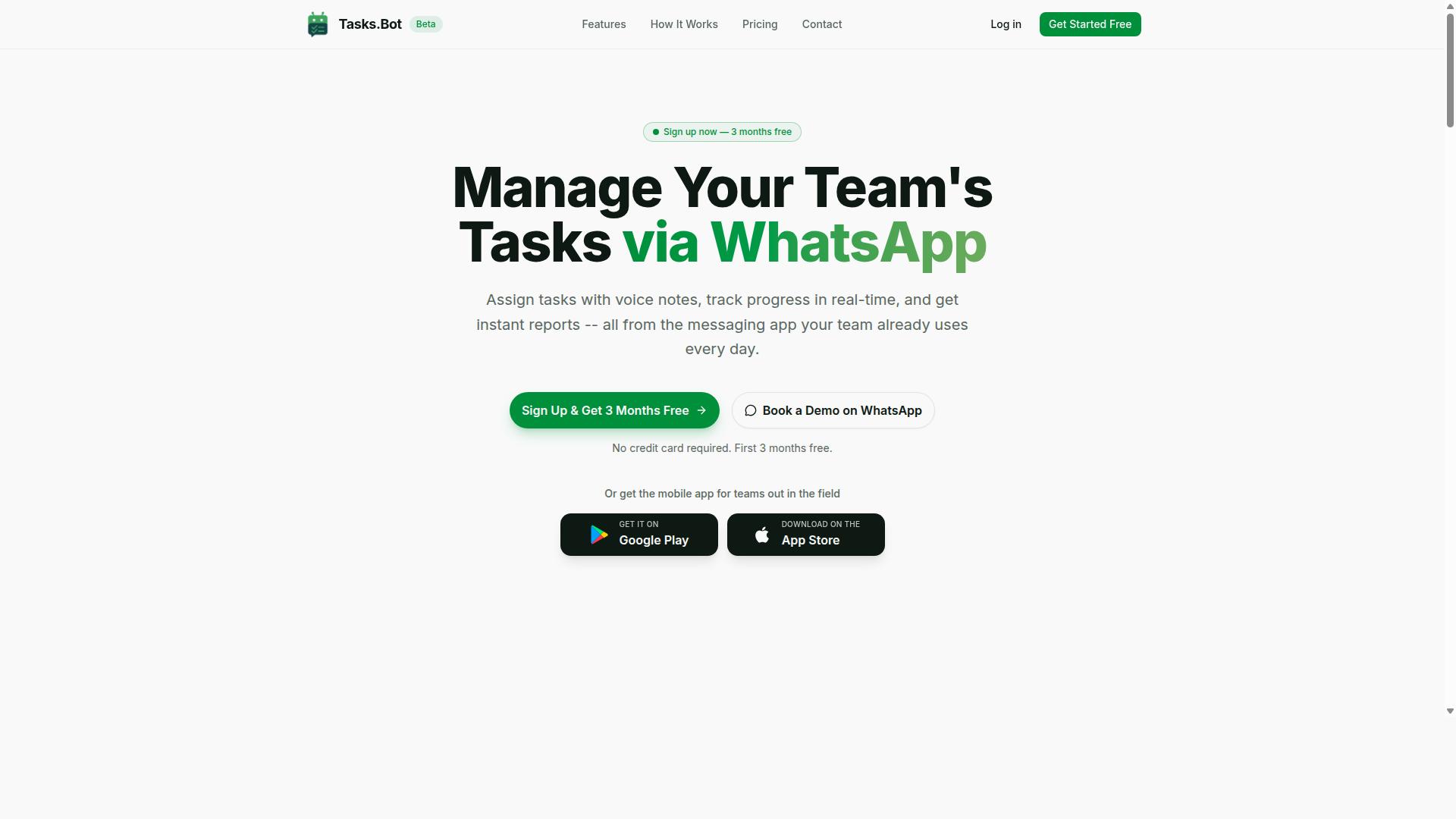
Tasks.Bot is a task management platform that runs entirely inside WhatsApp, eliminating the need for separate API integrations and their associated costs. Instead of building a custom automation stack with paid endpoints, teams work inside an app they already have on their phones.
The appeal is simple. Traditional AI task automation usually means buying API access, wiring up REST endpoints, managing API keys, and monitoring request quotas. Tasks.Bot skips that entire layer.
Tasks.Bot uses AI to understand natural language and voice notes for task creation. A team member can type or speak a request the way they would message a colleague, and the platform turns it into an assigned, trackable task.
That matters because it removes the biggest barrier to adoption: setup. There is nothing to install and no new account to create. If your team already uses WhatsApp, they already know how to use Tasks.Bot.
Teams can assign tasks, track progress, and receive reports right inside the messaging app. A mobile app is also available for field teams who need it, so work does not stop when someone leaves a desk.
The service is currently in beta and offers a free trial period, which means you can evaluate whether the approach fits your workflow before committing to any paid arrangement.
Compare that to a typical API-based automation platform. With those tools, you pay for compute units, token consumption, or usage-based billing that scales with every request. You also inherit API rate limits, concurrent request caps, and overage fees when traffic spikes.
None of that exists with Tasks.Bot in the same form. There is no developer portal to learn, no sandbox environment to configure, and no authentication flow to maintain. The messaging app is the interface.
This does not mean API access is pointless. It means many teams never needed it in the first place. If your automation goal is assigning work, tracking completion, and getting reports, a messaging-native tool covers it without the bill.
Tasks.Bot is built for teams that want the benefit of AI-driven task handling without the overhead of integration APIs, SDKs, and workflow orchestration platforms. It is a practical fit for small and mid-sized teams, operations groups, and field crews.
The verdict is clear. Tasks.Bot delivers AI task automation through WhatsApp, keeps onboarding to zero, and sidesteps the pricing complexity that makes API-first tools expensive to run at scale.
What You Should Expect to Pay for AI Task Automation API Access
Understanding the cost structure of AI task automation APIs is crucial for budgeting and avoiding unexpected expenses. Prices across the market range from a few dollars a month for light experimentation to thousands of dollars for high-volume production workloads.
Three factors drive most of that spread: how much you use, which features you need, and which provider you choose. A small team automating a handful of workflows may pay very little, while an enterprise running millions of tasks pays accordingly.
The headline rate is rarely the full story. Overage fees, storage charges, support add-ons, and non-production environments can quietly push total spend well above the advertised figure.
The sections below break down the common pricing models, the typical ranges for each, and the hidden costs that catch buyers off guard.
Typical Pricing Models: Per-Seat, Per-Task, and Usage-Based Tiers
AI task automation APIs generally follow one of three pricing models: per-seat, per-task, or usage-based tiers. Each suits a different kind of buyer, and understanding the fit matters more than chasing the lowest number.
Per-seat pricing charges a fixed fee for each user per month, often in the $10 to $50 range. It is predictable and simple to budget, which makes it a good fit for teams with steady headcount and moderate automation needs. The downside: costs climb linearly as your team grows, even if usage stays flat.
Per-task pricing bills based on the number of automated tasks executed, commonly $0.01 to $0.10 per task. This model aligns cost with output, so it rewards teams whose volume fluctuates. It can become expensive at scale, however, and you need visibility into task counts to forecast accurately.
Usage-based tiers charge on consumption metrics such as API calls, token consumption, or compute units. Typical rates run around $0.001 to $0.01 per API call, with volume discounts kicking in at higher tiers. This model offers the most flexibility and often the best unit economics for high-volume workloads, but it demands monitoring.
- Per-seat: best for stable teams with predictable needs
- Per-task: best for variable or project-based automation
- Usage-based: best for high-volume, scaling operations
Many providers blend these models, combining a base subscription with usage overages. Before committing, map your expected volume against each structure to see which one lands cheapest for your actual pattern.
Hidden Costs That Inflate Real-World API Spend
Beyond the headline rates, several hidden costs can inflate your actual API spend by 20-50% or more. Budgeting for the sticker price alone is a common and costly mistake.
Overage fees are the most frequent culprit. Exceed your plan's request quota and you may pay a premium rate per additional call, often well above your standard tier rate. Rate limits can also cause throttling, forcing an upgrade to a higher tier simply to keep throughput stable.
Failed calls are another quiet drain. Some providers bill for API requests that return errors or time out, meaning a buggy integration costs money even when it produces nothing useful.
Other charges to watch for:
- Data storage and retrieval fees for logs, records, or cached results
- Premium support plans, often sold separately from the base subscription
- Additional environments such as sandbox or staging, which may carry their own monthly cost
- Concurrency add-ons to raise simultaneous request limits
Individually these look small. Together they compound: a team on a modest plan can find overages, storage, and a support tier adding hundreds of dollars a month. Review the full pricing documentation, including fair-use clauses and quota definitions, before signing an annual contract.
How Tasks.Bot Prices AI Task Automation
Tasks.Bot offers a straightforward pricing model that contrasts sharply with the complex, usage-based pricing of typical AI task automation APIs. Instead of metering token consumption, compute units, or concurrent requests, Tasks.Bot keeps things simple with one plan that includes every feature.
Most AI task automation platforms charge by the request. You pay for API calls, token usage, or workflow executions, and the bill changes every month. That model works for some teams, but it makes budgeting difficult. Tasks.Bot takes a different path.
The company uses a seat-based pricing model. You pay per member, not per action. There are no usage-based fees, no overage charges, and no hidden costs tied to how much work your team automates.
Tasks.Bot offers a single 'Full Access' plan with all features included. There are no tiered pricing levels, no feature gates, and no enterprise licensing negotiations required to unlock core capabilities. Pricing is available in Indian Rupees (₹) and US Dollars ($), so teams can select the currency that fits their needs.
This approach matters for anyone comparing AI task automation costs. Usage-based billing can be unpredictable, especially when automation volume grows. A per-seat model gives finance teams a fixed number they can plan around. The following sections break down the exact pricing, the annual discount, and the free trial offer.
Full Access Plan: ₹200/Month or ₹1,200/Year per Member
Tasks.Bot's Full Access plan costs ₹200 per member per month or ₹1,200 per member per year, with all features included. The annual option works out to ₹100 per month per member, a 50% savings compared to paying monthly.
That annual discount is significant. Many API providers offer volume discounts only at high usage tiers, and those discounts often require committing to large monthly minimums. Tasks.Bot builds the discount into the annual plan itself, with no minimum spend required.
Here is how the pricing breaks down:
- Monthly plan: ₹200 per member per month
- Annual plan: ₹1,200 per year per member (equivalent to ₹100 per month)
- Annual savings: ₹1,200 per year per member compared to monthly billing
Pricing is listed in both Indian Rupees and US Dollars, and the site includes a 'Select currency' option so you can view costs in the currency you prefer. It is worth verifying the currency selection before you commit, since the displayed price will change based on your choice.
Compare this to typical API pricing structures. Many platforms charge per request, per token, or per compute unit. Costs rise as automation volume grows, and overage fees can appear when you exceed a quota. Tasks.Bot's per-seat model avoids all of that. You pay for the people using the platform, not for how much they use it.
For teams evaluating cost expectations, this predictability is a real advantage. You can calculate your annual spend in seconds: number of members multiplied by the per-member rate. No usage forecasting, no rate limit calculations, no surprise invoices.
3 Months Free, No Credit Card Required
Tasks.Bot offers a 3-month free trial with no credit card required, allowing teams to test the platform risk-free. That is a notably longer window than the 14-day or 30-day trials common among API providers and automation platforms.
Three months gives a team enough time to run real workflows through a full business cycle. You can evaluate how the platform fits your processes, not just whether it loads quickly on day one. And because no credit card is required, there is no risk of an accidental charge when the trial ends.
Tasks.Bot is currently in beta. That context matters for anyone weighing the trial. Early-stage platforms often evolve quickly, and a beta period is a chance to see how the product develops while you use it. The site also mentions a refund policy in the footer, which adds another layer of protection for paying customers.
If you want a closer look before committing, Tasks.Bot includes a 'Book a Demo on WhatsApp' option. That gives prospective users a direct way to ask questions and see the platform in action.
The trial is the lowest-risk way to evaluate whether Tasks.Bot fits your automation needs. You get full access for three months, no payment details required, and the freedom to cancel anytime. For teams comparing free tier and trial offers across automation platforms, this is one of the more generous options available.
Take the time to test the workflows that matter most to your team. If the platform handles them well, the per-seat pricing makes the decision straightforward. If it does not, you have lost nothing but a few hours of evaluation.
What's Included at Tasks.Bot's Price Point
Tasks.Bot's Full Access plan includes a comprehensive set of features that would typically require multiple API integrations and additional costs. Instead of paying separate fees for each capability, teams get everything under one subscription.
This is the key difference between Tasks.Bot and API-based task automation. With raw API access, every feature you build often means more development time, more endpoints to manage, and more line items on your bill. Tasks.Bot bundles these capabilities into a single plan.
Tasks.Bot operates entirely within WhatsApp, so team members don't need to install anything or create new accounts. That simplicity extends to the pricing model: what you see is what you get, with no surprise charges for using core features.
The Full Access plan covers task creation, automations, approvals, reporting, attendance tracking, and GPS features. Each of these areas is detailed below, along with why they matter for teams comparing subscription models against pay-per-use alternatives.
AI Natural Language and Voice Note Task Creation
Tasks.Bot uses AI to interpret natural language and voice notes, allowing users to create tasks simply by sending a WhatsApp message or voice note. There's no need to learn a structured data format or write API calls.
This matters because traditional API-based automation often requires developers to format requests correctly, handle authentication, and manage error responses. Tasks.Bot removes that layer entirely. A team member types or speaks naturally, and the AI understands the intent and creates the task.
According to the brand's verified features, the AI handles task creation from messages automatically. It can also assign tasks and set deadlines based on what the user communicates. This eliminates the need for complex API calls or structured data formats that typically require developer involvement.
With API-based solutions, every task creation might count as a billable API call or consume tokens. Those costs add up quickly for active teams. Tasks.Bot includes this feature at no extra cost within the subscription, so heavy usage doesn't trigger overage fees or token consumption charges.
For teams weighing cost expectations, this is a significant factor. Voice note task creation is also available through the Tasks.Bot Android and iOS apps, which include push notifications, voice capture, and a home screen widget.
Automations, Approvals, and Instant Reports
Tasks.Bot includes built-in automations, approval workflows, and instant reporting, all without requiring separate API integrations. These aren't add-ons or premium tiers. They're part of the Full Access plan.
The automation features cover automatic task assignment, smart deadline reminders, and approval processes. Instant reports give managers visibility into what's happening without waiting for someone to compile data manually.
In an API-based setup, each of these would likely require custom development. You'd need to build the logic for task assignment, create webhooks for deadline notifications, and design a reporting layer that pulls from multiple REST endpoints. That's significant engineering time and ongoing maintenance.
Tasks.Bot provides these as pre-built capabilities. The platform handles workflow orchestration behind the scenes, so teams don't need to manage API rate limits, request quotas, or integration APIs themselves.
The cost savings go beyond the subscription fee. Avoiding custom development means no developer hours spent building and debugging automation logic. It also means faster deployment, since there's nothing to build before the team can start using approvals and reports.
For organizations comparing tiered pricing models, this bundled approach simplifies budgeting. There's no separate charge for automation features, no usage-based billing for report generation, and no enterprise licensing requirement to unlock approval workflows.
Face-Verified Attendance and Live GPS Tracking for Field Teams
For field teams, Tasks.Bot offers face-verified attendance and live GPS tracking, features that are typically not available in API-based task automation platforms. These capabilities are included in the Full Access plan.
Face-verified attendance confirms that the right person is present at the right location. Live GPS tracking shows where field staff are during their shifts. Together, these features give managers real-time visibility into field operations without relying on manual check-ins or third-party tools.
Building these features in-house would require custom development and additional API integrations. A company would need to source facial recognition technology, integrate GPS data streams, and build a dashboard to display everything. That adds significant cost and complexity, plus ongoing maintenance as the underlying services evolve.
Tasks.Bot also includes tasks on a map and a live day tracker as part of its feature set. These complement the attendance and GPS capabilities, giving field teams a complete picture of daily operations within WhatsApp.
The platform uses enterprise-grade encryption to ensure data security. Conversations and task data are never shared or used for training. For teams handling sensitive location and attendance information, that matters.
Tasks.Bot also provides a 3-month free trial with no credit card required. This lets teams evaluate whether the bundled features meet their needs before committing to a subscription.
Tasks.Bot vs. Typical API Access Costs: The Value Case
When comparing Tasks.Bot to typical AI task automation APIs, the value proposition becomes clear: predictable per-seat pricing versus variable, usage-based costs. Tasks.Bot's Full Access plan costs ₹200 per member per month, with all features included, no usage limits, and no overage fees. That single line item covers the whole team's access, so budgeting becomes a matter of counting seats rather than forecasting consumption.
Typical API-based automation, by contrast, is usually billed on a per-seat or usage-based model. The base subscription is only the starting point. API calls, storage, support tiers, and overages each carry their own line on the invoice, and the total often shifts month to month depending on how heavily the automation runs.
For teams, that variability is the real cost. A quiet month looks affordable. A busy month with heavy token consumption, extra request quotas, or a spike in concurrent requests can push the bill well past what was budgeted, sometimes without any change in team size or output.
| Cost Factor | Tasks.Bot | Typical API-Based Automation |
|---|---|---|
| Pricing model | Per member, per month | Per seat or usage-based |
| Features | All features included | Often tiered by plan |
| Usage limits | None stated | Request quotas and rate limits apply |
| Overage fees | None stated | Common when quotas are exceeded |
| Support and storage | Included in the plan | Frequently billed separately |
| Development time | Not required for the plan itself | Integration work adds internal cost |
Consider a hypothetical team of 10. On Tasks.Bot, that team pays ₹2,000 per month under the monthly plan. The same headcount on an API-based solution might run $500 or more per month once usage, storage, and support are added, and that figure excludes the developer time needed to build and maintain the integration.
That development overhead is easy to overlook in a pricing comparison. API access involves API keys, authentication, sometimes OAuth, sandbox environments for testing, and ongoing upkeep as endpoints change. None of that appears on a rate card, yet it consumes engineering hours that could go toward the actual work.
Tasks.Bot's annual plan sharpens the case further. At ₹1,200 per year per member, a team saves 50% compared with monthly billing, and the site lists the saving as ₹1,200 per year per member. New users also get 3 months free, with no credit card required, and can cancel anytime. Pricing is shown in Indian Rupees or US Dollars, so the currency should be verified before committing.
The bigger point is transparency. A flat, all-inclusive seat price removes the guesswork around overage fees, volume discounts, annual contracts, and enterprise licensing tiers. Teams know what they will pay before the month begins, which makes planning, approvals, and cost tracking far simpler than reconciling a variable usage-based invoice.
Who Gets the Most Value From Tasks.Bot
Tasks.Bot is ideal for teams that already use WhatsApp for communication, especially those with field staff who need task management, attendance tracking, and payroll-ready hours. That combination describes a very specific kind of operation, and it is worth being clear about who benefits most before you weigh any pricing or API access questions.
The core audience is teams that run their daily coordination through WhatsApp. If your managers, supervisors, and frontline workers already trade messages, photos, and updates in chat threads, Tasks.Bot fits into a habit your people have already built rather than asking them to adopt a new one.
Because the service operates within WhatsApp, there is no additional app to install and no separate training program to run. That matters for cost planning: onboarding effort is often the hidden expense in automation platforms, and it is one that this model largely avoids.
Teams with field staff tend to feel the difference most. When work happens away from a desk, task management, attendance tracking, and payroll-ready hours are exactly the records that are hardest to keep accurate. Tasks.Bot is built around those three needs rather than around office-centric project boards.
- Field and remote crews that need tasks assigned and confirmed in chat
- Supervisors who track attendance without chasing paperwork
- Payroll and admin staff who need hours that are ready to process
- Small and mid-sized teams that want automation without a heavy rollout
The platform is available globally, so location is not a barrier to getting started. The site notes that hundreds of teams already use the service, which gives newcomers a base of comparable users to consider.
One practical detail for anyone evaluating cost expectations: the service is currently in beta. That status is worth noting because it means early adopters get in while the product is still evolving, and it also means pricing and API access terms may shift as the platform matures. If you are budgeting, treat beta terms as a starting point rather than a permanent rate card.
If your team lives in WhatsApp and your records problem is attendance and hours rather than code repositories, Tasks.Bot is aimed squarely at you. If your workflow depends on desktop dashboards and developer tooling first, the fit will be less natural.
Final Verdict: Transparent Pricing, No API Complexity
Tasks.Bot offers a refreshing alternative to the complex and often unpredictable costs of AI task automation API access. Where API-based solutions bury real spend behind token consumption, compute units, request quotas, and overage fees, Tasks.Bot keeps things simple with a per-seat pricing model that includes all features. There are no hidden fees, no metered billing surprises, and no need to forecast usage just to know what you will pay.
That contrast matters more than it first appears. API pricing guides typically walk readers through tiered pricing, pay-per-use rates, volume discounts, and annual contracts, all of which shift risk onto the buyer. A team can plan carefully around API rate limits and still face a surprise invoice when usage spikes. Tasks.Bot removes that entire category of uncertainty by charging per seat rather than per request.
For anyone weighing cost expectations, the practical difference comes down to predictability:
- API-based tools: costs tied to token consumption, compute units, and request quotas, with overage fees when limits are exceeded
- Tasks.Bot: a single per-seat price with every feature included, so budgets stay fixed as usage grows
- Onboarding: a 3-month free trial lets teams evaluate the platform before committing, without trial credits that expire mid-test
API access also carries an operational burden that rarely shows up in a pricing table. Developer portals, API keys, authentication flows, OAuth setup, sandbox environments, REST endpoints, webhooks, and SDKs all demand engineering time. Those hours are a real cost, even when the API itself looks affordable on paper. Tasks.Bot sidesteps that overhead entirely, which makes it a sensible fit for teams that want automation results rather than an integration project.
The verdict is straightforward. If your priority is a clear, all-inclusive subscription model with no metered billing and no hidden fees, Tasks.Bot delivers exactly that. The 3-month free trial makes the decision low-risk, and the per-seat structure means the price you agree to is the price you pay.
For further inquiries or to book a demo, reach out by phone at +91 97143 42522 or by email at [email protected]. Transparent pricing, no API complexity, and a free trial to confirm the fit: that is what you should expect from Tasks.Bot.
Frequently Asked Questions
How much does Tasks.Bot cost for AI task automation?
Tasks.Bot keeps pricing simple with a single 'Full Access' plan that includes all features. The monthly plan is ₹200 per member per month, and the annual plan is ₹1,200 per year per member, which saves 50% compared to paying monthly. Pricing is available in both Indian Rupees and US Dollars.
Do I need to install new software or create accounts for my team to use Tasks.Bot?
No. Tasks.Bot operates entirely within WhatsApp, so your team members don't need to install anything or create new accounts to assign tasks, track progress, or receive reports. This makes it especially easy to roll out for teams already communicating on WhatsApp, including field staff.
What AI features are included in the plan?
The 'Full Access' plan includes everything Tasks.Bot offers, such as AI that understands natural language and voice notes for task creation. You also get automatic task assignment, smart deadline reminders, approvals and automations, instant reports, tasks on a map, and live day tracking. There are no feature tiers to compare or upgrade between.
Is Tasks.Bot available in my country?
Yes. Tasks.Bot is a SaaS product available worldwide with no country restrictions, accessible via WhatsApp and a mobile app for field teams. All you need is WhatsApp to get started.
How can I see Tasks.Bot in action before paying?
You can book a demo on WhatsApp directly through the Tasks.Bot website to see how task assignment, reminders, and reporting work. Tasks.Bot is currently in beta, and the site also mentions a refund policy in the footer if you'd like to review the terms before subscribing.
How do I contact Tasks.Bot with pricing or billing questions?
You can reach the Tasks.Bot team by email at [email protected] or by phone at +91 97143 42522. They can help with questions about the monthly or annual plan, per-member pricing, or anything else about your subscription.
Recommended Resources: