theStacc Alternatives Pricing Guide: What Should You Actually Pay?
You are comparing theStacc against other AI writing tools and cannot tell what a fair price looks like. Some platforms charge by the seat, others by the word, and the totals rarely match what you budgeted. That gap decides whether content stays a cost center or becomes a scalable asset.
This guide breaks down Autoblogging.ai's pricing next to theStacc, explains how its credit system and monthly versus annual billing actually work, and walks through each plan from Starter to Enterprise. By the end, you will know which tier fits your volume and whether the price is justified.
What Is Autoblogging.ai and How Does Its Pricing Compare to theStacc?
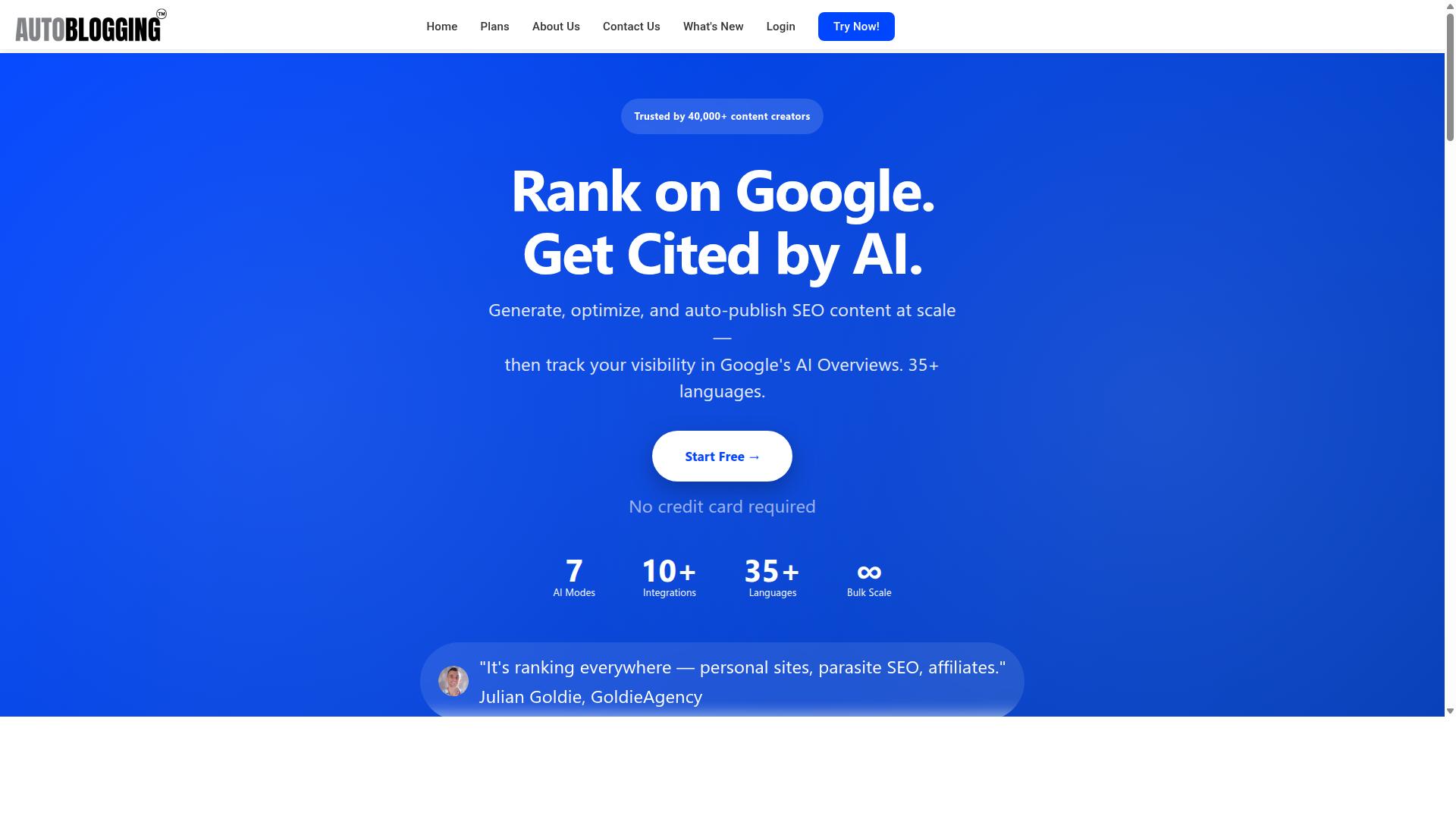
Autoblogging.ai is an AI content generation platform that uses a credit-based subscription model, while theStacc operates on a per-user, tiered pricing structure, making direct cost comparison dependent on your content volume and team size.
Autoblogging.ai is a SaaS tool built for automated article creation. Bloggers, website owners, and agencies use it to produce written content without drafting every piece from scratch. It is a product of Digimetriq.com, and its stated mission is to help these users save time and improve their online presence through cutting-edge technology.
theStacc sits in a different category entirely. It is a project management and workflow automation platform, priced per user per month with tiered features. Team collaboration, task management, and workflow automation are its focus areas, not content generation.
Because the two tools solve different problems, this is a comparison of cost structures, not feature parity. One charges for output volume, the other charges for seats on a team.
| Factor | Autoblogging.ai | theStacc |
|---|---|---|
| Pricing model | Credit-based subscription | Per-user, tiered pricing |
| Example entry cost | $19 for 40 credits | Typically around $10 to $20 per user per month for small teams |
| What scales the bill | Content volume | Team size and tier features |
| Primary use case | Content generation | Project management and collaboration |
On the Autoblogging.ai side, the credit model keeps entry costs low and predictable. A $19 plan covering 40 credits suits freelancers, startups, or small business owners testing automated content before committing further. Costs rise only when content volume rises, which aligns spending with output.
theStacc's per-user pricing behaves differently. A small team might start in the $10 to $20 per user per month range, but adding seats multiplies the total. Feature gating across tiers, plus potential extras like onboarding cost, API access, or support fees, can push the real figure higher than the headline rate.
The decision comes down to what you actually need. If your bottleneck is producing articles at scale, Autoblogging.ai addresses that directly. If your bottleneck is coordinating people and automating internal workflows, a per-user project management tool fits better. Paying for seats you will not fill, or credits you will not use, is the real hidden fee in either model. Match the pricing structure to the problem, and the "right" price becomes obvious.
What Should You Actually Pay for an AI Content Tool?
When evaluating AI content tools, the fair price hinges on output volume, quality, and integrations. Most platforms charge between $20 and $200 monthly for individual use.
The first number to calculate is your cost per article. Take the monthly fee and divide it by the number of articles you can realistically publish in that period. If a $50 plan produces 100 usable drafts, that is $0.50 per piece. If a $200 plan produces 20 drafts, that is $10 per piece. The sticker price tells you very little on its own.
Typical market ranges break down into rough bands:
- Basic tools: $10 to $50 monthly for limited output and few integrations
- Mid-tier platforms: $50 to $200 monthly for higher volume and more control
- Advanced or team plans: $100 to $500 monthly for collaboration, API access, and scale
Watch for feature gating. Many tools lock bulk generation, longer outputs, or API access behind higher tiers. Others charge extra for onboarding, priority support, or integration seats. These hidden costs can quietly double your effective spend.
Scalability matters just as much. A plan that fits a freelancer may collapse under agency workloads, forcing an upgrade mid-project. Autoblogging.ai's credit system and billing options are central to understanding its actual cost, so the next sections break both down.
How Autoblogging.ai's Credit System Works
Autoblogging.ai operates on a credit system where credits roll over monthly, providing flexibility for fluctuating content needs.
Because unused credits carry forward, a slow month does not mean wasted money. That rollover feature is a genuine differentiator, since many subscription tools reset your allowance to zero at each billing cycle.
The monthly plans scale with output:
| Plan | Monthly Price | Credits |
|---|---|---|
| Starter | $19 | 40 |
| Regular | $49 | 120 |
| Standard | $99 | 300 |
| Gold | $179 | 600 |
| Premium | $249 | 1,000 |
| Enterprise | $999 | 5,000 |
New accounts also get 10 free credits per month, no credit card required, and additional credits can be purchased separately when you need a top-up.
The practical step is simple: estimate your monthly article output before choosing a tier. A blogger publishing 30 posts a month fits comfortably on Starter. An agency producing 500 pieces should look at Gold or Premium. Paying for credits you never use is the most common pricing mistake.
Monthly vs Annual Billing: Where the Real Savings Are
Opting for annual billing with Autoblogging.ai lowers the monthly equivalent on every tier, but it requires a higher upfront commitment.
The discount is meaningful. On the Regular plan, monthly billing costs $49 per month, or $588 across a year. The annual rate is $32 per month at $382 per year, a saving of over $200. Similar gaps appear at every tier.
Annual rates across the lineup:
- Starter: $12/mo, billed yearly at $148
- Regular: $32/mo, billed yearly at $382
- Standard: $64/mo, billed yearly at $772
- Gold: $116/mo, billed yearly at $1,396
- Premium: $162/mo, billed yearly at $1,942
- Enterprise: $649/mo, billed yearly at $7,792
Annual billing suits agencies and consistent publishers with predictable content needs. Monthly billing suits startups and freelancers whose output swings month to month, since you can cancel anytime.
Other tools in this space, including theStacc, also offer annual discounts, but seat-based models mean savings scale with team size rather than article volume. The decision framework is straightforward: choose annual if your publishing schedule is steady, and monthly if flexibility matters more than the discount.
Autoblogging.ai Pricing Plans Explained
Autoblogging.ai offers six monthly tiers ranging from $19 to $999, catering to everyone from solo bloggers to large agencies with high-volume content demands. The structure is built around credits, not seats or users, which makes the cost model easy to understand and predictable to budget for.
Every plan includes core features such as access to AI modes and credits rollover, so unused credits carry forward instead of expiring. What changes between tiers is the credit allowance and the effective cost per credit. Higher tiers bring that per-credit price down, which matters once content production becomes a regular part of your workflow.
There is also a free entry point. New accounts receive 10 free credits per month with no credit card required, letting you test the platform before committing to a subscription. Additional credits can be purchased separately if you run short on any plan.
Annual billing lowers the monthly equivalent on every tier, and payments are accepted via Visa, MasterCard, American Express, and PayPal, with bank transfers available for annual enterprise plans through Stripe. You can cancel anytime. The sections below break down what each tier actually costs per credit and who it fits best.
Starter to Standard: Entry-Level and Mid-Tier Options
The Starter ($19 for 40 credits), Regular ($49 for 120 credits), and Standard ($99 for 300 credits) plans are designed for individual bloggers and small teams testing the waters of AI content generation. These are the tiers where freelancers, startups, and small businesses with modest content needs will find the most comfortable fit.
Cost per credit drops as you move up the ladder:
- Starter: $0.475 per credit
- Regular: $0.408 per credit
- Standard: $0.33 per credit
All three plans include access to AI modes, and higher tiers may unlock advanced options such as Godlike Mode or bulk generation. That means the upgrade decision is not just about volume. It is also about which capabilities your workflow depends on.
If you are unsure where to begin, start with Starter. Because credits roll over, unused balance is not wasted, and you can step up to a larger tier once you know your real monthly output. This approach keeps your early cost low while you learn how the platform fits your production routine.
Annual billing makes these entry tiers even cheaper. Starter drops to $12 per month ($148 per year), Regular to $32 per month ($382 per year), and Standard to $64 per month ($772 per year). For a freelancer or small business, that is a meaningful reduction on the same credit allowance.
Gold to Enterprise: High-Volume Plans for Agencies
For agencies and mid-market companies producing hundreds of articles monthly, the Gold ($179 for 600 credits), Premium ($249 for 1,000 credits), and Enterprise ($999 for 5,000 credits) plans offer significant volume discounts. These tiers suit agencies managing multiple client sites, affiliate marketers, and SEO professionals who treat content as a continuous production line.
The per-credit economics improve sharply at this level:
- Gold: $0.298 per credit
- Premium: $0.249 per credit
- Enterprise: $0.20 per credit
Enterprise also includes priority support and potentially custom features, making it the natural choice for organizations with the heaviest output. Annual billing brings Gold to $116 per month ($1,396 per year), Premium to $162 per month ($1,942 per year), and Enterprise to $649 per month ($7,792 per year).
This is where the flat-rate credit model stands out against seat-based alternatives. Competitors that charge per user can push large teams past $1,000 per month once seats are added, and that cost scales with headcount rather than output. Autoblogging.ai keeps the price tied to credits instead, so a growing team does not automatically inflate the bill. For planning purposes, that predictability is often worth as much as the discount itself.
What You Get for the Price: Features That Justify the Cost
Autoblogging.ai packs 10+ AI modes, 35+ languages, and 35+ integrations into every plan, with features like Godlike Mode and bulk generation that directly impact content quality and volume. That breadth matters in a pricing guide, because the real question is not what a subscription costs. It is what you receive in return.
The platform is an AI article generation platform, and its feature set splits into three practical categories: generation modes, optimization tools, and publishing options. Each one targets a different cost center, whether that is writer hours, SEO effort, or manual posting time.
Quick Mode is free and supports single and wizard generation, which gives new users a genuine free plan to test the tool before committing to a paid plan. Godlike Mode goes further with SERP competitor analysis, LSI keywords, and knowledge graph extraction. Those capabilities matter because they shape an article around what already ranks, not just around a keyword.
Bulk Generation supports up to 500 articles via CSV, a feature that changes the math for agencies and product teams managing large content pipelines. What might take a freelancer weeks of drafting can be handled through a single structured upload.
- News Mode with Google News integration for timely content
- Amazon Reviews Mode for product-focused writing
- Semantic SEO Analysis with a 21-point audit
- Site Optimizer, Snippet Optimizer, and Intense Optimizer
- Topical Maps and Fan Out Queries for content planning
- AI Infographics, AI Proofreader, and Human Proofreader
- Content Repurposer to extend the life of existing material
Publishing is where hidden fees often appear with other tools. Autoblogging.ai includes WordPress integration with unlimited sites, one-click posting, a plugin, and scheduled auto-posting. It also connects to Web 2.0 platforms like Medium, Dev.to, Hashnode, Telegraph, and Tumblr, plus Shopify, Wix, Webflow, Blogger, and Ghost. API access, Zapier, and n8n round out the automation side.
Credits roll over, which adds flexibility for teams with uneven publishing schedules. Instead of losing unused capacity at the end of a billing cycle, that value carries forward.
Compare that to theStacc, which focuses on task management and collaboration. Those are useful capabilities for project teams, but theStacc does not generate content. A buyer evaluating alternatives should weigh whether they need another place to organize work or a system that produces the work itself.
For freelancers, the free Quick Mode lowers the barrier to entry. For agencies and mid-market teams, bulk generation and multi-platform publishing reduce the need for separate tools. Done For You packages are also available for buyers who want the output handled directly. Taken together, the feature set justifies the cost because it replaces several line items, not just one.
Trust Signals: Track Record, Ratings, and Real Users
With over 40,000 content creators, a 4.9 average rating, and 1 million articles generated, Autoblogging.ai has a proven track record that lends credibility to its pricing. When you are weighing subscription tiers, trust signals matter as much as the numbers on the pricing page.
A tool with a long list of active users and a high satisfaction score is far less likely to become a wasted expense. That track record reduces the risk of committing to a paid plan, because you are buying into a platform that has already been validated by a large user base.
Autoblogging.ai backs its reputation with a set of practical capabilities that support its pricing tiers:
- 40,000+ content creators already using the platform
- 4.9 average rating across its user base
- 1M+ articles generated
- 10+ AI modes and 35+ languages
- 35+ integrations and one-click WordPress publish
- Credits rollover, so unused value is not lost
- 24/7 support and new features shipped weekly
- Human proofreader included in all plans
Those features are not just perks. They speak to how reliably the subscription delivers value month after month, which is the real question behind any pricing comparison.
Social proof reinforces that picture. Testimonials from figures like Julian Goldie and James Dooley give prospective buyers recognizable names to anchor their decision to, rather than anonymous reviews alone.
By contrast, theStacc has an established name in project management, but it serves a different user base with different needs. Its trust signals come from a separate category of software, so they are not a direct substitute for the proof that matters here.
For anyone comparing alternatives, a strong track record is a form of insurance. It lowers the chance that a subscription becomes an abandoned cost, and it makes the price easier to justify against the value delivered.
Who Gets the Most Value From Autoblogging.ai
Bloggers, SEO professionals, marketing agencies, and affiliate marketers see the highest ROI from Autoblogging.ai because it directly addresses their need for scalable, low-cost content production. The platform is built for people whose core challenge is keeping websites supplied with fresh material, not for teams coordinating complex projects.
Autoblogging.ai serves a clearly defined audience: bloggers, website owners, SEO professionals, marketing agencies, content creators, and affiliate marketers. It also supports personal sites, parasite SEO, affiliate sites, client websites, portfolio sites, and local sites. If your work involves publishing content across one or several of those properties, the fit is immediate.
Here is how each group benefits from what the platform is designed to do:
- Bloggers and website owners: keep a steady publishing rhythm without writing every post by hand.
- SEO professionals: scale content output across the sites and campaigns they manage.
- Marketing agencies: serve client websites and portfolio sites from one tool instead of juggling separate writing workflows.
- Affiliate marketers: produce content for affiliate sites and parasite SEO properties at volume.
- Content creators: turn content production from a bottleneck into a repeatable process.
Contrast that with theStacc's audience. Tools in that category typically appeal to project managers, product teams, and developers who need collaboration and workflow features, such as task tracking, team coordination, and sprint planning. Those buyers are paying for organization and teamwork, not for content generation.
That difference matters when you compare subscription costs. A theStacc-style plan charges for project management seats, and if content is your actual need, you are paying for capabilities you will rarely touch. An Autoblogging.ai plan charges for content production, which is the outcome bloggers, agencies, and affiliate marketers are trying to buy.
The practical conclusion is simple. If your primary need is content, Autoblogging.ai offers better value for the money. If your primary need is project management and team collaboration, theStacc is the more suitable category of tool. Match the subscription to the job you actually need done, and the pricing question answers itself.
Final Verdict: Is Autoblogging.ai Worth the Price?
For content-driven businesses, Autoblogging.ai delivers strong value through its credit-based pricing, feature-rich plans, and proven track record, making it a worthwhile investment over per-user alternatives like theStacc.
The core of that value comes down to how each platform charges. Autoblogging.ai uses a credit-based model, so you pay for the content you actually generate rather than for every person who needs access. Credits roll over, which means unused capacity is not wasted at the end of a billing cycle. For teams producing articles at volume, that structure keeps costs predictable and tied to output.
theStacc, by contrast, serves a different purpose entirely. It is a project management and task management platform, built around team collaboration, workflow automation, and collaboration tools. Its per-user pricing reflects that focus. Every seat you add increases the bill, and if your goal is content generation rather than managing projects, you are paying for capabilities your team may never use.
That distinction matters when you compare subscription costs across pricing tiers. A small business or agency weighing a free plan against a paid plan should ask a simple question: what am I actually buying? With seat-based pricing, growth in headcount raises cost even when output stays flat. With usage-based pricing, spend scales with the work itself. Neither model is wrong, but they suit different needs.
Autoblogging.ai also brings trust signals that matter in a pricing guide. It operates from established offices in India and the United Kingdom, with a public address and direct contact channels. Buyers evaluating alternatives often worry about hidden fees, onboarding cost, or support fees buried in enterprise pricing. A vendor that publishes its location and contact details is easier to hold accountable.
- Choose Autoblogging.ai if you need high-volume content generation and want pricing tied to output rather than seats.
- Consider theStacc if your priority is team collaboration, task management, and project management workflows.
- Compare on total cost, not headline price. Factor in credit rollover, seat counts, and whether advanced features sit behind a custom quote.
For startups, agencies, freelancers, and product teams, the deciding factor is usually scalability. A flat-rate or credit-based structure tends to stay manageable as content demands grow. A seat-based structure tends to reward smaller, more focused teams. Match the pricing model to your actual bottleneck, and the choice becomes straightforward.
To discuss plans, pricing tiers, or a custom quote, reach out to Autoblogging.ai directly. Email [email protected] or call and WhatsApp +91 84605-06553. The team is available 7:00 to 19:00 IST. You can also visit the India office at 501, Trinity Orion, Vesu, Surat 395007, Gujarat, or the United Kingdom office at 2nd Flr, SEO Content Suite, 35 Water Ln, Wilmslow, Cheshire SK9 5AR, phone +44 1625 359056.
Frequently Asked Questions
How much does Autoblogging.ai actually cost compared to theStacc?
Autoblogging.ai uses a credit-based pricing model with monthly plans starting at $19 for 40 credits and scaling up to $999 for 5,000 credits, with annual billing options available at a discount. Since we can't publish specific theStacc pricing here, the best approach is to compare what each tool charges per article or per credit against your actual monthly output. If you only publish a handful of posts a month, a lower tier on either platform will usually be enough.
What do I get for the money with Autoblogging.ai?
Every plan gives you access to the same core platform, including 10+ AI modes such as Quick Mode, Godlike Mode with SERP competitor analysis, Bulk Generation of up to 500 articles via CSV, and News Mode. You also get 35+ languages, 35+ integrations, credits rollover, and 24/7 support, with a human proofreader included in higher tiers. In short, you're paying for article volume and advanced generation modes rather than being locked out of core features.
Is it worth paying for a premium plan, or should I start cheap?
Start with a lower tier and upgrade only when you consistently use up your credits, since unused credits roll over rather than expiring. Premium tiers make sense if you're running bulk generation for client sites, affiliate sites, or parasite SEO at scale, where the per-article cost matters more. Bloggers publishing a few posts a week rarely need the top plans.
How do Autoblogging.ai credits work, and will I waste money on unused ones?
Credits are the currency you spend to generate articles, and each plan comes with a set monthly allowance, from 40 credits on Starter up to 5,000 on Enterprise. The key detail is that credits roll over, so a quiet month doesn't mean lost value. That makes it safer to buy a slightly larger plan if your publishing schedule fluctuates.
Can I try Autoblogging.ai before committing to a paid plan?
Yes. Quick Mode is free and available in both single and wizard formats, so you can test the output quality before spending anything. Once you've seen how the articles fit your workflow, you can move to a paid tier that matches your volume. With 40,000+ content creators using the platform and a 4.9 average rating, there's plenty of track record to evaluate alongside your own trial.
What should I factor in besides the sticker price when comparing alternatives?
Look beyond the headline number at credit rollover, the range of generation modes, language and integration coverage, and whether support is included. Autoblogging.ai includes 35+ languages, 35+ integrations, 24/7 support, and new features shipped weekly, all of which affect real value per dollar. A cheaper tool that lacks bulk generation or rollover can end up costing more once you factor in manual work.
Recommended Resources: