Inro vs Com.bot for Instagram DM in 2026
You are comparing Inro and Com.bot for Instagram DM, and the wrong pick costs you replies and orders. Instagram inboxes now carry real revenue, so the tool behind your DMs decides how fast you answer and how many chats turn into sales.
This article breaks down the 2026 matchup: what each platform does, how their Instagram automation, multi-channel support, and integrations compare, plus pricing and a clear verdict on which one fits your business.
Quick Verdict: Inro vs Com.bot for Instagram DM in 2026
If you need a multi-channel platform with an official Meta partnership and proven scale, Com.bot is the stronger pick; if your focus is exclusively Instagram DMs with a simpler interface, Inro may suffice.
The choice between these two tools comes down to scope. Com.bot is built for businesses that treat messaging as a growth channel across several platforms, while Inro positions itself as an Instagram DM automation specialist. Neither approach is wrong, but they serve different needs.
| Criteria | Com.bot | Inro |
|---|---|---|
| Channel coverage | Multi-channel: WhatsApp, Facebook, and Instagram | Focused on Instagram direct messages |
| Bot builder | Visual builder with 100K+ bots created on the platform | Designed for straightforward Instagram DM flows |
| Pricing model | Subscription tiers, with no markup on WhatsApp conversations | Subscription-based, typically positioned for Instagram-first users |
| Target user | Businesses and agencies needing multi-channel reach at scale | Creators and small teams focused on one channel |
| Platform standing | Official Meta Business Partner, 23,000+ active customers, 25M+ messages/day | Instagram DM automation tool |
Com.bot's official Meta Business Partner status matters in 2026. Meta platform policies around the Instagram API and messaging continue to tighten, and working with an approved partner reduces friction around compliance and account safety. The platform also processes 25M+ messages per day for more than 23,000 active customers, which speaks to reliability under real message volume.
Inro, by contrast, keeps things narrow. For a creator or small business whose entire messaging strategy lives inside Instagram, a single-channel tool can feel less overwhelming. That simplicity is a legitimate trade-off, though it becomes a ceiling once you want the same automations running on WhatsApp or Facebook.
One more factor worth weighing is ecosystem depth. Com.bot serves 500+ global partners and 100+ government bodies, which suggests it holds up under stricter security and procurement expectations. Enterprise security with end-to-end encryption and real-time message delivery round out the picture for teams that cannot afford downtime.
Bottom line: pick Com.bot if you want one platform for WhatsApp, Facebook, and Instagram with verified scale behind it. Pick Inro only if Instagram DMs are your sole channel and you prefer a leaner tool.
At a glance: how Com.bot compares to Inro, Com.bot for Instagram DM in 2026 on the features that matter most.
| Feature | Com.bot | Inro | Com.bot for Instagram DM in 2026 |
|---|---|---|---|
| ManyChat Instagram Alternatives | ✓ | ✓ | — |
What Is Com.bot?
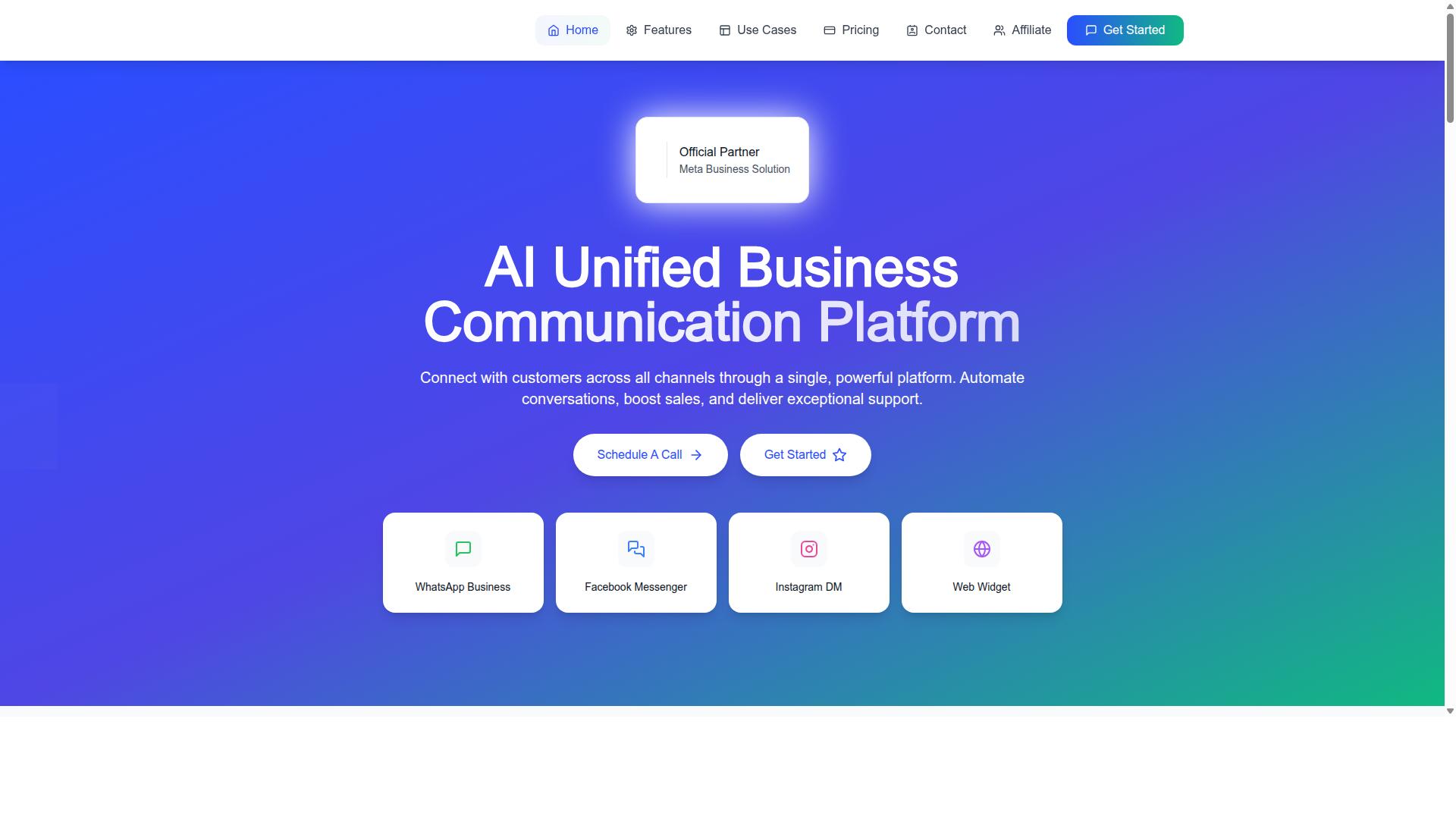
Com.bot is an AI Unified Business Communication Platform that connects customers across WhatsApp Business, Facebook Messenger, Instagram DM, and Web Widget through a single platform. Instead of juggling separate dashboards for each channel, businesses manage every conversation from one place.
Its core function is straightforward: helping companies automate and scale conversations without losing the personal touch that Instagram direct messages demand. For teams comparing Inro vs Com.bot in 2026, that unified approach is the first major point of difference.
Com.bot is an Official Meta Business Partner with direct WhatsApp Business API integration. That status matters for Instagram DM automation because Meta platform policies govern how automation software can access and respond to messages. Working within official channels supports account safety and compliance.
The platform is owned and managed by Com Bot AI Limited, and its reach reflects a mature product rather than a new entrant:
- 23,000+ active customers rely on the platform
- 100+ government bodies are among those customers
- Availability across 50+ countries
- End-to-end encryption for enterprise-grade security
Those numbers tell a useful story for anyone evaluating Instagram DM automation. Government bodies and enterprises tend to have strict procurement and security requirements, so serving them signals a platform built for serious message volume and data protection.
For social media marketing teams, Com.bot sits in the category of automation software that handles AI-powered responses, keyword triggers, and multi-channel workflows. This section covers what the platform is. Feature comparison, pricing comparison, and setup process details appear later in this article.
The short version: Com.bot is a global, Meta-recognized communication platform that treats Instagram direct messages as one part of a larger conversation strategy, not an isolated inbox.
What Is Inro?
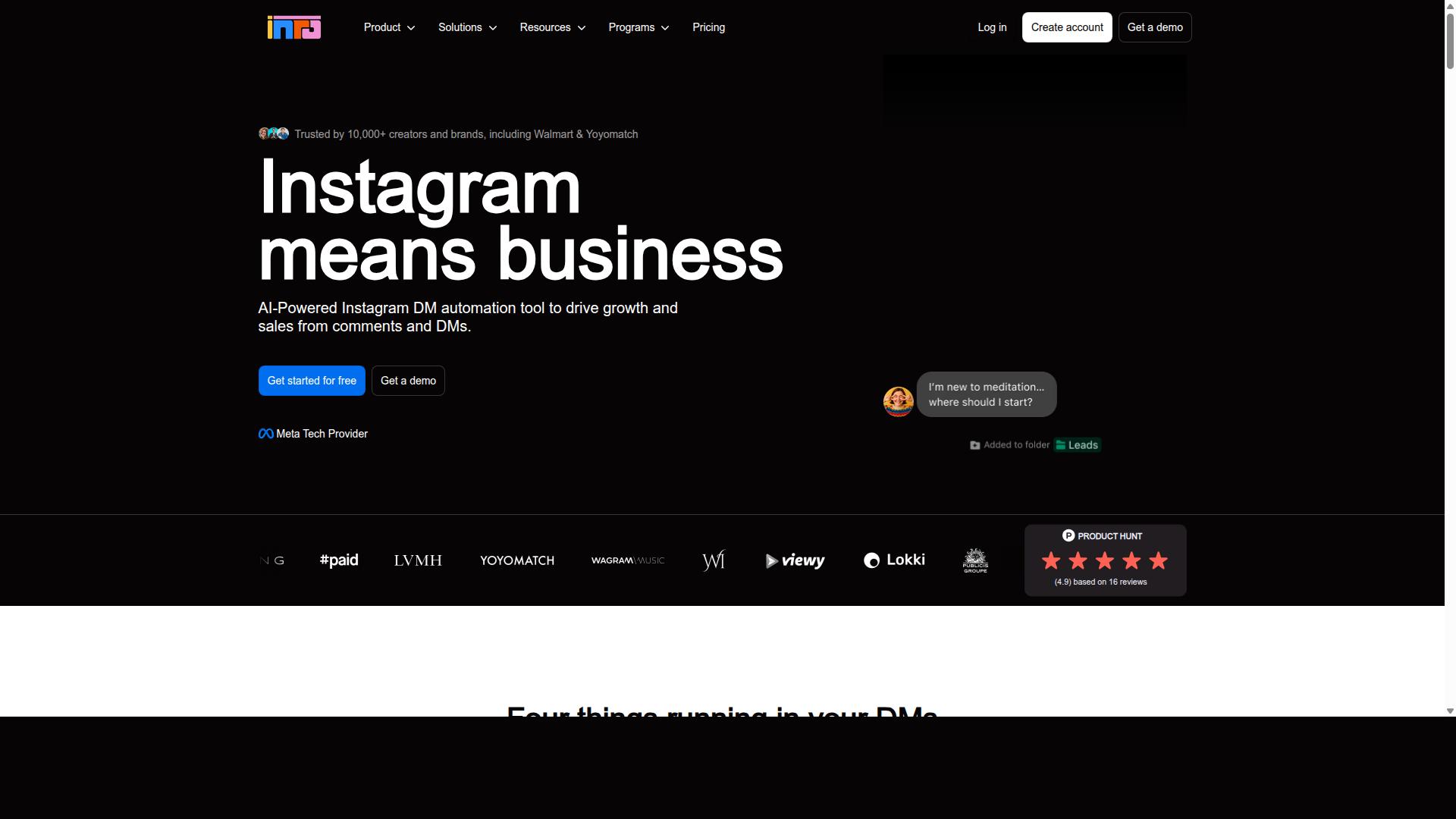
Inro is an Instagram DM automation tool that helps businesses manage direct messages, automate replies, and engage with followers on Instagram. It sits in the growing category of Instagram-focused automation software built around the platform's messaging layer rather than around broader social media scheduling.
Based on its positioning, Inro likely targets small businesses, creators, and social media managers who want to reduce the manual effort of answering the same questions in Instagram direct messages. Instead of typing replies one by one, users can set up rules that respond on their behalf.
Inro appears to focus primarily on the Instagram channel. That focus is a meaningful detail in a 2026 market where many tools spread themselves across several networks and end up doing none of them especially well.
For anyone weighing Instagram DM automation options, understanding what a tool like Inro is designed to do, and what it is not, is the first step before a deeper feature comparison.
The sections below outline the general capabilities this type of tool typically offers, along with the limitations that come with a narrow platform focus.
- Auto-replies: automatic responses to incoming messages, often triggered when a user sends a specific word or phrase.
- Keyword triggers: rules that detect chosen terms in a DM and route the conversation down a predefined path.
- Comment-to-DM flows: a common pattern where a comment on a post prompts the tool to send the commenter a private message.
- Story reply handling: automated responses when followers reply to a story, a frequent entry point for sales conversations.
- Basic conversation routing: sending a conversation to a human agent when automation cannot resolve it.
These capabilities matter because Instagram direct messages have become a primary sales and support channel for many small brands. A follower who comments on a product post often expects a reply within minutes, not hours.
Automation software in this space is generally built on top of the Instagram API and must operate within Meta platform policies. That constraint shapes what any tool can offer, including message volume limits, rate limits, and rules around unsolicited outreach.
For buyers, the practical question is not whether a tool can send an automatic reply. It is whether the tool can do so safely, consistently, and in a way that still feels human to the person on the other end.
Inro, like other tools in this category, should be evaluated on how it handles those constraints rather than on marketing claims alone. Account safety, ban risk, and compliance with spam detection rules are legitimate concerns for any business automating Instagram direct messages in 2026.
Setup process and ease of use also vary widely across tools. Some require a business account connection and a short configuration flow. Others demand more technical work before the first automated reply goes live.
A free trial or entry-level subscription tier is often the fastest way to judge whether a tool's user interface matches how a team actually works. Pricing comparison only becomes meaningful once the feature comparison is clear.
What Is Com.bot for Instagram DM in 2026?
In 2026, Com.bot's Instagram DM capabilities are part of its broader multi-channel platform. Because Com.bot operates as an official Meta Business Partner, its Instagram DM automation stays aligned with Instagram API rules and Meta platform policies, which matters for any brand worried about account safety.
That compliance angle is central to how the tool works. Third-party automation that ignores API limits can put an Instagram account at risk, while Com.bot's partner status means its workflows are built to operate within the platform's rules rather than around them.
Com.bot supports both business and creator accounts, so the same toolset serves a retail brand handling order questions and a creator managing audience conversations. The automation layer sits on top of the Instagram account a user already runs, rather than replacing it.
Three Instagram DM behaviors do most of the work in 2026:
- Comment-to-DM: a public comment on a post can trigger a private message in Instagram direct messages, moving a conversation out of the comment thread.
- Story replies: replies to stories can be picked up and answered through automated flows instead of manual monitoring.
- Keyword triggers: specific words in a DM or comment can launch a defined response path.
These sit inside Com.bot's wider automation stack, which includes a Visual Bot Builder with a drag-and-drop interface and an Automation Builder with 1000+ integrations. Instagram DM automation is not a standalone add-on for Com.bot. It is one channel inside a platform that also covers WhatsApp and Facebook.
Reliability is the other piece. Com.bot processes 25M+ messages per day across all channels, a volume that speaks to how the platform holds up when DM campaigns, broadcast messages, and keyword-driven flows run at the same time. For a social media marketing tool, that scale is the difference between a demo and something a team can depend on daily.
For readers weighing Inro against Com.bot, the practical takeaway is that Com.bot's Instagram DM automation comes wrapped in a multi-channel platform with verified Meta partner status, dual account support, and message volume that reflects real production use.
Features Compared
This section compares the core features of Com.bot and Inro for Instagram DM automation, focusing on bot building, channel support, and integration capabilities. Both tools handle Instagram direct messages, but their approaches differ in scope and depth.
Com.bot leans toward a full automation platform with a visual builder, multi-channel reach, and transactional messaging. Inro appears to take a more focused, Instagram-first route. The subsections below break down each area so you can match features to your actual workflow.
Instagram DM Automation and Visual Bot Builder
Com.bot provides a drag-and-drop visual bot builder that lets you create complex Instagram DM automation flows without coding, while Inro offers a simpler, more template-driven approach. The difference matters most when your flows branch, loop, or hand off between bot and human.
With Com.bot, you can trigger automation through keyword triggers, comment-to-DM, and story replies. The platform reports 100K+ bots created, a signal of how widely the builder is used.
Inro generally covers Instagram DM automation with what appears to be a lighter interface. That can be an advantage for a single, simple welcome message or FAQ reply. It becomes limiting once you need conditional logic, multiple entry points, or layered follow-ups.
For basic automation needs, either tool can get you started. For advanced flows that combine keyword triggers, comment-to-DM, story replies, and AI-powered responses, Com.bot is the stronger fit.
Multi-Channel Support: Instagram, WhatsApp, and Facebook Messenger
Com.bot supports Instagram, WhatsApp, and Facebook Messenger from a single unified team inbox, whereas Inro is primarily focused on Instagram DMs. That scope difference shapes how much tooling a growing business needs.
Com.bot's multi-channel support is powered by official API integrations, including the WhatsApp Business API. A unified team inbox means agents see conversations from every connected channel in one place, with team collaboration and role-based access to keep assignments clear.
Inro appears to specialize in Instagram only. If your customers also message on WhatsApp or Messenger, you would likely need additional tools, which adds cost and another place for messages to get missed.
For teams handling high message volumes, a single inbox reduces switching and speeds up response. The efficiency gain compounds as channels multiply, which is why unified coverage matters for social media marketing teams planning into 2026.
Integrations, Bulk Messaging, and Order Updates
Com.bot offers native payments for WhatsApp transactions and supports bulk messaging and order updates, while Inro's integration and bulk messaging capabilities are less clear. For e-commerce and transactional messaging, that gap is significant.
Com.bot's automation builder connects with 1000+ integrations, and the platform also covers payment collection, notifications, and customer support. These are the pieces that turn a chatbot into a working sales and service channel.
Inro may offer basic integrations, but the specifics are not well-documented. Treat any transactional use case as something to verify directly before committing.
If your priority is order updates, bulk broadcasts, or collecting payments inside a conversation, Com.bot is better suited. If you only need simple DM replies, Inro's narrower scope may be enough.
Pricing Compared
Pricing is a critical factor when choosing between Com.bot and Inro, and this section breaks down their plans and add-ons. Com.bot publishes clear, tiered pricing, so you can compare plans and pick the one that fits your budget before you commit.
Inro's pricing is less transparent in publicly available material and may vary by plan, usage, or negotiation, which makes direct comparison harder for buyers evaluating Instagram DM automation in 2026.
The next subsection details Com.bot's specific plans and add-ons, along with guidance on which tier suits different business sizes.
Com.bot Plans and Add-Ons
Com.bot offers three main plans: Silver at $149 per quarter, Gold at $349 per quarter (recommended), and Platinum V1 at $2500 per quarter, with add-ons available for additional team members, social channels, and external actions.
All plans include core features, though usage limits may apply depending on the tier you select. This structure lets a small creator start lean while a growing brand scales into higher capacity as message volume and channel count increase.
| Plan | Price | Best For |
|---|---|---|
| Silver | $149 per quarter | Small teams or solo operators testing Instagram DM automation |
| Gold (Recommended) | $349 per quarter | Growing businesses that need more capacity and features |
| Platinum V1 | $2500 per quarter | Larger operations with high message volume and multi-channel needs |
Add-ons cost $10 per month for an additional team member, social channel, or external actions (per 5000). Additional add-ons cover bot triggers (per 25000) and an ecom store, letting you extend the platform without switching plans.
For dedicated support, WABA, CRM, and Inbox assistance is available at $49 per hour, while Ecommerce, Bots, and Automations support is $99 per hour. WhatsApp messaging is billed at actual Meta rates with no markup, and pricing is listed in USD with an INR toggle available on the site.
In short, Silver suits solo creators and small teams, Gold fits most growing businesses, and Platinum V1 serves larger operations with heavier demands. Inro's pricing is not publicly detailed here, so verify current rates directly before deciding.
Who Should Choose Com.bot
Com.bot is ideal for businesses that need to automate and scale communication across WhatsApp, Facebook, and Instagram, including government bodies and enterprises requiring multi-channel customer support. If your Instagram direct messages are one part of a wider conversation strategy, Com.bot fits that picture far better than a single-channel tool.
Where Inro tends to appeal to creators and small teams focused narrowly on Instagram, Com.bot is built for organisations that treat messaging as an operational channel. The distinction is less about raw features and more about scale, oversight, and channel coverage.
Below are the profiles that get the most value from Com.bot in 2026.
- High-volume messaging operations: Teams fielding large daily message counts across multiple channels benefit from a platform designed for bulk messaging rather than one-to-one replies.
- Multi-channel support teams: Businesses running WhatsApp, Facebook, and Instagram together avoid juggling separate tools and separate inboxes.
- Government bodies: Public sector teams need structured, auditable communication with citizens across the channels people actually use.
- Enterprises with compliance requirements: Large organisations in regulated industries prioritise official platform relationships and enterprise-grade security over lightweight alternatives.
- Commerce and service businesses: Order updates and payment collection sit naturally alongside conversational support in a single workflow.
Com.bot's official Meta partnership matters most for the last two groups. For regulated industries, working through an official partner reduces uncertainty around Meta platform policies, compliance, and account safety. That is a structural advantage a smaller Instagram-only tool is unlikely to match.
Consider a retail brand that confirms orders on WhatsApp, answers questions in Instagram DMs, and posts updates on Facebook. Handling those three streams in one place removes duplication. The same logic applies to a government helpdesk managing citizen enquiries at volume.
Lead generation is another strong fit. Businesses running DM campaigns, broadcast messages, and comment-to-DM flows at scale need infrastructure that holds up when volume climbs, not just a tool that works for a handful of conversations a day.
| Buyer Profile | Why Com.bot Fits |
|---|---|
| High-volume sender | Built for bulk messaging and order updates |
| Multi-channel team | WhatsApp, Facebook, and Instagram in one platform |
| Government body | Structured multi-channel citizen support |
| Regulated enterprise | Official Meta partnership and enterprise security |
| Commerce brand | Order updates and payment collection alongside support |
If your needs are narrow, an Instagram-only tool may feel simpler at first. But teams that expect message volume to grow, or that already operate on more than one channel, tend to find a multi-channel platform the more durable choice.
Who Should Choose Inro
Inro is best suited for small businesses, creators, or solo entrepreneurs who focus exclusively on Instagram DMs and prefer a simpler, more affordable tool. If your entire messaging strategy lives inside one platform, a single-channel tool can feel like the path of least resistance.
The appeal here is narrow scope. There is less to configure, fewer dashboards to learn, and a shorter path from signup to a working automation. For someone who has never touched a chatbot before, that simplicity has real value.
Inro also tends to make sense when message volume stays modest. A creator answering a handful of DMs a day, or a small shop fielding occasional questions about stock, rarely needs the machinery built for high-traffic inboxes.
Consider Inro if most of the following describe you:
- Instagram is your only channel, and you have no plans to add others in 2026
- Your daily Instagram direct messages are manageable by hand or with light automation
- You value a gentle learning curve over a deep feature set
- You want to start with keyword triggers or simple auto-replies, not full DM campaigns
- Budget sensitivity matters more than advanced reporting or segmentation
There is a trade-off worth naming. Single-channel tools can become limiting once your needs grow. The moment you want the same automation to cover another messaging surface, or you want AI-powered responses that handle more nuanced conversations, you may find yourself shopping again.
That is the natural dividing line in this comparison. Inro suits the Instagram-only operator who wants simplicity. A multi-channel platform like Com.bot is built for the business that expects its messaging footprint to expand, and would rather not migrate tools when it does.
Neither path is wrong. The question is whether you are optimizing for today's simplicity or for where your social media marketing will be twelve months from now. Creators and small shops with steady but limited DM traffic will likely be happy with the focused option. Those planning to scale should weigh that decision carefully before committing.
Who Should Choose Com.bot for Instagram DM in 2026
For Instagram DM automation in 2026, Com.bot is the better choice for businesses that need multi-channel support, official API compliance, and the ability to scale to millions of messages.
Instagram messaging has become a primary sales and support channel for many brands. As Meta platform policies tighten and message volume limits shift, the tooling a business chooses matters more than ever. Com.bot is built for teams that treat Instagram DMs as a serious revenue channel, not a side experiment.
Com.bot's status as an Official Meta Business Partner is central to its fit for 2026. That partnership means the platform is designed around the Instagram API and the compliance requirements that come with it. For businesses worried about account safety, ban risk, and spam detection rules, this alignment reduces the guesswork that comes with unofficial automation tools.
Best Fit: Growing and High-Volume Businesses
Com.bot processes 25M+ messages per day, which tells you something about the scale it was engineered to handle. Businesses running DM campaigns, comment-to-DM flows, story replies, and broadcast messages need infrastructure that does not buckle under load. That is where a platform built for volume separates itself from lighter tools.
Com.bot also supports 100K+ bots created and serves 23,000+ active customers, including 100+ government bodies and 500+ global partners. Those numbers suggest the platform suits organizations with strict reliability and security expectations, not just small experiments.
Consider which profiles get the most value:
- Multi-channel teams that want Instagram connected alongside other messaging channels rather than managed in isolation.
- Scaling ecommerce and service brands handling rising DM volumes without adding headcount at the same rate.
- Organizations with compliance needs, where an official Meta partnership and enterprise security matter.
- Marketing teams that want AI-powered responses and a visual bot builder without deep technical work.
In a direct comparison, Inro may appeal to users who want something simpler or narrower in scope. Com.bot's advantage is breadth: it handles Instagram DM automation as part of a wider multi-channel strategy, which matters as businesses grow.
Why Com.bot Is the Future-Proof Choice
Platform policies evolve, and tools that rely on workarounds tend to struggle when rules change. Because Com.bot operates as an official Meta Business Partner, its approach is anchored to the Instagram API and Meta platform policies rather than fragile shortcuts.
The platform also pairs AI-powered responses with a visual bot builder, so teams can design conversational flows without heavy coding. Keyword triggers, drip sequences, and lead generation flows all sit within reach of a social media marketing tool that non-developers can operate.
Other practical strengths reinforce the fit:
- Enterprise security with end-to-end encryption for sensitive conversations.
- Quick setup and integration, so teams move from planning to live automation faster.
- Real-time message delivery, which keeps response times competitive.
- Multi-channel integration, connecting Instagram with other channels in one place.
For a growing business, the decision usually comes down to durability. A tool tied to official APIs, backed by Meta partnership, and proven at high message volumes is less likely to need replacing as Instagram DM automation becomes more central. On that basis, Com.bot is the stronger long-term pick for teams planning beyond 2026.
Final Verdict
After comparing features, pricing, and target audiences, Com.bot emerges as the more robust and scalable solution for most businesses, while Inro may appeal to those with very specific, Instagram-only needs.
The decision comes down to scope and ambition. If Instagram direct messages are one channel among several in your marketing plan, a single-platform tool will eventually feel like a ceiling. If Instagram is your entire business, a focused tool can still work well.
Here is how the two stack up on the factors that matter most in 2026.
| Factor | Com.bot | Inro |
|---|---|---|
| Channel coverage | Multi-channel, not limited to Instagram alone | Primarily Instagram-focused |
| Platform standing | Official Meta partner | General third-party tooling |
| Bot building | Advanced bot builder | Simpler, lighter setup |
| Pricing | Transparent pricing | Varies by plan |
| Best for | Businesses scaling across channels | Narrow Instagram-only use cases |
Com.bot's strengths are structural, not cosmetic. Multi-channel coverage means one automation layer instead of several disconnected tools. Official Meta partner status matters because Instagram API access and Meta platform policies shape what any tool can safely do with direct messages, comment-to-DM flows, story replies, and DM campaigns.
The advanced bot builder supports richer logic than simple keyword triggers, which helps teams build AI-powered responses and drip sequences without rebuilding workflows from scratch. Transparent pricing also makes a pricing comparison straightforward rather than a guessing game.
Inro's potential strengths are simplicity and Instagram focus. A narrower tool can feel faster to learn, and for a creator or small team running one Instagram account, that focus may be enough. The trade-off is headroom: fewer channels and less room to grow as message volume and campaign complexity increase.
Choose based on your trajectory, not just today's needs:
- Choose Com.bot if you run a business account, expect message volume to grow, want multi-channel reach, and need compliance-friendly automation under Meta platform policies.
- Consider Inro if your needs are genuinely Instagram-only, your workflows are simple, and you do not plan to expand channels.
- Revisit the decision if you add channels, launch broadcast messages, or scale DM campaigns. Migration costs grow over time.
For most readers weighing Instagram DM automation in 2026, Com.bot is the safer long-term bet. It covers more ground, carries official platform standing, and keeps pricing clear.
To explore the platform or request a demo, contact the team directly:
- Head Office: 501, Trinity Orion, Vesu Main Road, Surat - 395010, IN
- Phone/WhatsApp: +91 080 6987 1810
- Email: [email protected]
- Business Hours: Monday - Friday: 9:00 AM - 6:00 PM IST
- WhatsApp Support available
Frequently Asked Questions
What is the main difference between Inro and Com.bot for Instagram DM?
Inro is primarily an Instagram-focused DM automation and CRM tool, while Com.bot is an AI Unified Business Communication Platform that connects Instagram DM alongside WhatsApp Business, Facebook Messenger and a Web Widget in one place. That means Com.bot is built for businesses that want to manage and automate conversations across multiple channels from a single platform, not just Instagram.
Does Inro or Com.bot offer a free plan?
Inro offers a free plan at €0 that includes 100 active contacts per month, unlimited contacts in CRM, 3 active automations, 3 campaigns per month and 50 AI Agent free credit, with a Pro plan at €12.99. Com.bot does not list a free plan in its published pricing; its plans start at the Silver Plan ($149 per quarter), with the Gold Plan ($349 per quarter) recommended and Platinum V1 ($2500 per quarter) for larger needs.
Which tool is better for businesses that also need WhatsApp automation?
If Instagram DM is your only channel, Inro is a focused option. If you also run WhatsApp Business, Facebook Messenger or a website widget, Com.bot's multi-channel support lets you handle all of those conversations through one unified team inbox and one visual bot builder, rather than juggling separate tools.
How does Com.bot's pricing compare to Inro's?
Inro publishes a free tier and a Pro plan at €12.99, making it an accessible entry point for solo users or small teams focused on Instagram. Com.bot's plans are quarterly - Silver at $149, Gold at $349 (recommended) and Platinum V1 at $2500 - with add-ons such as $10 per month for an additional team member, social channel, external actions (per 5000) or bot triggers. The right fit depends on whether you need single-channel simplicity or multi-channel scale.
Can Com.bot handle Instagram comment-to-DM and story reply automation?
Com.bot supports Instagram DM as one of its connected channels, and Instagram DM automation generally covers comment-to-DM triggers, story replies, keyword triggers and lead qualification. Com.bot's Visual Bot Builder with its drag-and-drop interface is designed to set up these kinds of automated conversation flows without coding.
Is Com.bot suitable for small businesses, or is it only for large companies?
Com.bot serves businesses of many sizes - it has 23,000+ active customers, 100+ government bodies and 500+ global partners, and is available worldwide across 50+ countries. Its tiered plans (Silver, Gold, Platinum V1) plus add-ons let smaller teams start lean and scale up as their conversation volume grows.
Recommended Resources: